We’re So Close To Finishing Up The Dry Build

We’re getting very close to finishing the dry build on our Quattro rally car and stripping the shell to paint it. Just a few final details need to be taken care of:

First, we decided now was the time to repair the cowl lip next to the right-side strut mount. At some time in the car’s life, it had got crushed and went a bit rusty. A bit rustier than we expected. We removed the crushed bits, cleaned up the rust and made a new part. We’ll weld it in next time we’re in the area with the welder.

Close-up of a CompBrake component with a blue anodized finish and visible metal corrosion on the surrounding area.
Close-up view of a welded joint with a gap in metal, showcasing rough edges and a blue round component in the background.
Close-up of a metal edge showing wear, with a blade and part of a rubber handle resting on it.

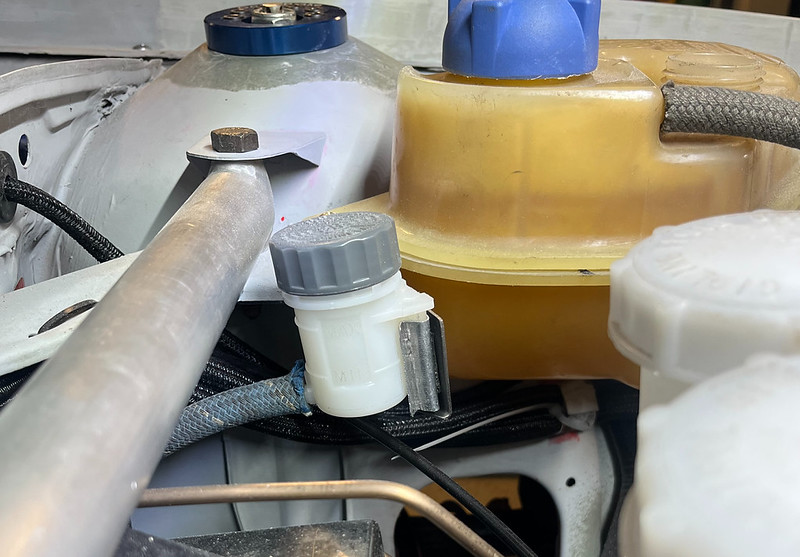
Then we moved on to selecting and mounting the clutch fluid reservoir. We initially tried a third brake fluid reservoir but it seemed bigger than necessary and proved hard to find a spot for. So we set about using a small Honda unit and coming up with a suitable location for it. We weren’t really happy with any of them until we settled on this, mostly because it allowed us to make a speed hole! More welding later.

A close-up view of a fluid reservoir with a blue cap and a secondary container, secured with tape, located in a vehicle's engine compartment.
Close-up view of a car engine bay featuring various components, including a fluid reservoir, metal pipes, and wiring. Some parts are labeled with tape, and a blue tape is visible on one of the components.
Close-up view of automotive engine components, including a coolant reservoir cap, metal pipe, and wiring with black tape.
Close-up view of automotive components, including a coolant reservoir with a blue cap and a white container with a gray lid, alongside metal pipes and wiring.

Next on the list was adding some side vents to the HVAC system. Originally, we’d thought about just leaving the vent tubes open, assuming they would not be impeded by the impending wiring loom.

Close-up view of a damaged metal ducting connected to a vehicle, with visible screws and surrounding metal components.
Close-up view of a mechanical assembly featuring a corrugated pipe, wiring harness, and electrical connectors.

But once that was in, we realized we might just have some room to terminate them in the exact same vents we had used in the dash. After trying one, we knew what we had to do. I ordered some more and some better ducting.

Interior view of a car showing ventilation system and metal framework.
Close-up of a mechanical component featuring a black connector and a gray electronic module, mounted on a metallic surface with visible screws and wiring.
A mechanical device with a black casing and a grille on the front, positioned on a workbench alongside measuring tools and other objects.
Interior view of a racing car showing an air vent mounted on the dashboard next to a metallic panel.

Leave a comment